
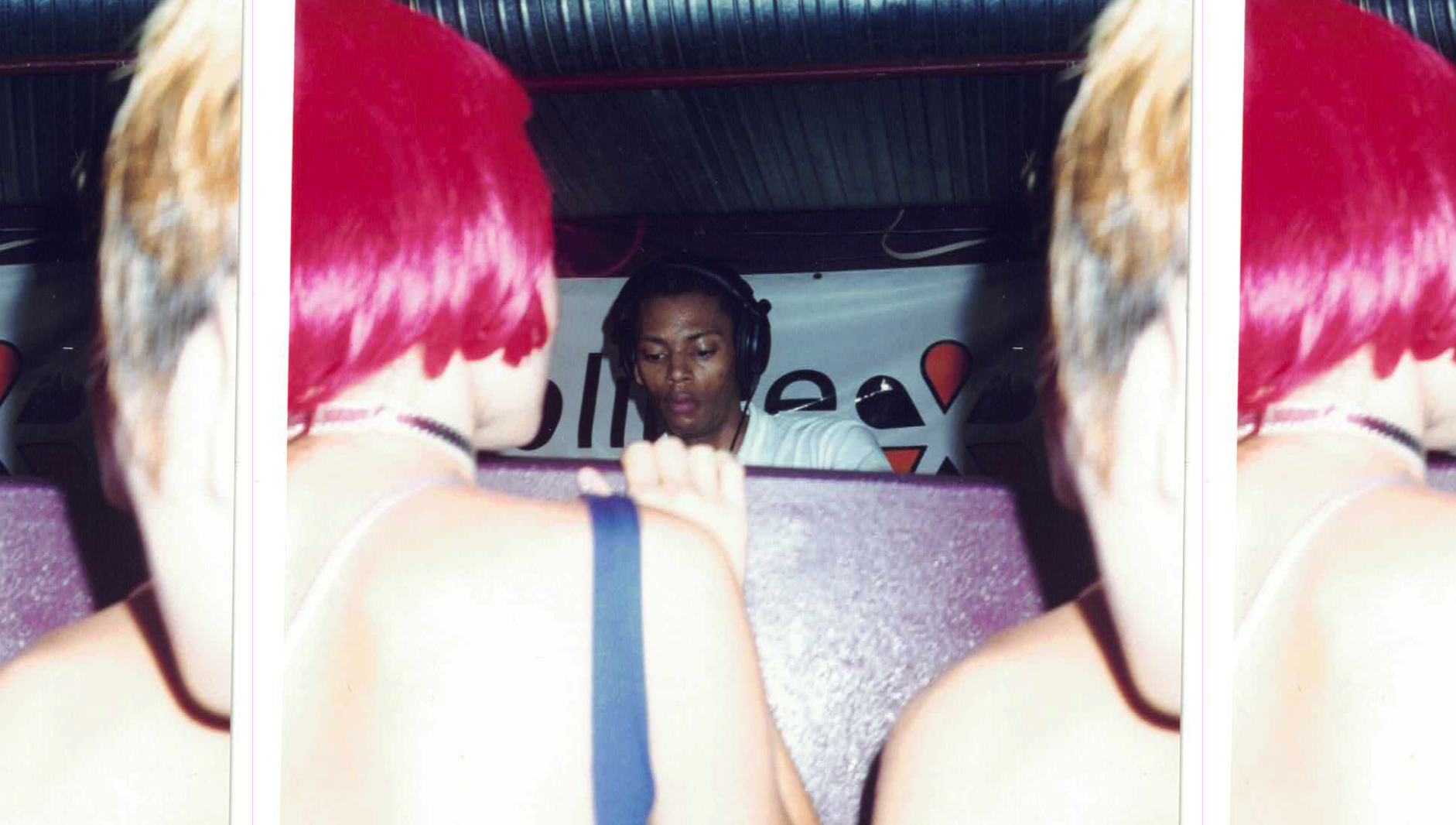
In the early hours of a March night in Sydney, the Hotel CBD was packed to capacity. Downstairs, the soundtrack was deep, jacking house. But everyone wanted to be upstairs, in a room with black plastic coating the walls and windows, creating a sweat-slicked, locked-in atmosphere. The year was 1997, and the reason for the fervour was Detroit techno maverick Jeff Mills playing - as the flyer promised - ‘For The First Time Ever in Australia.’
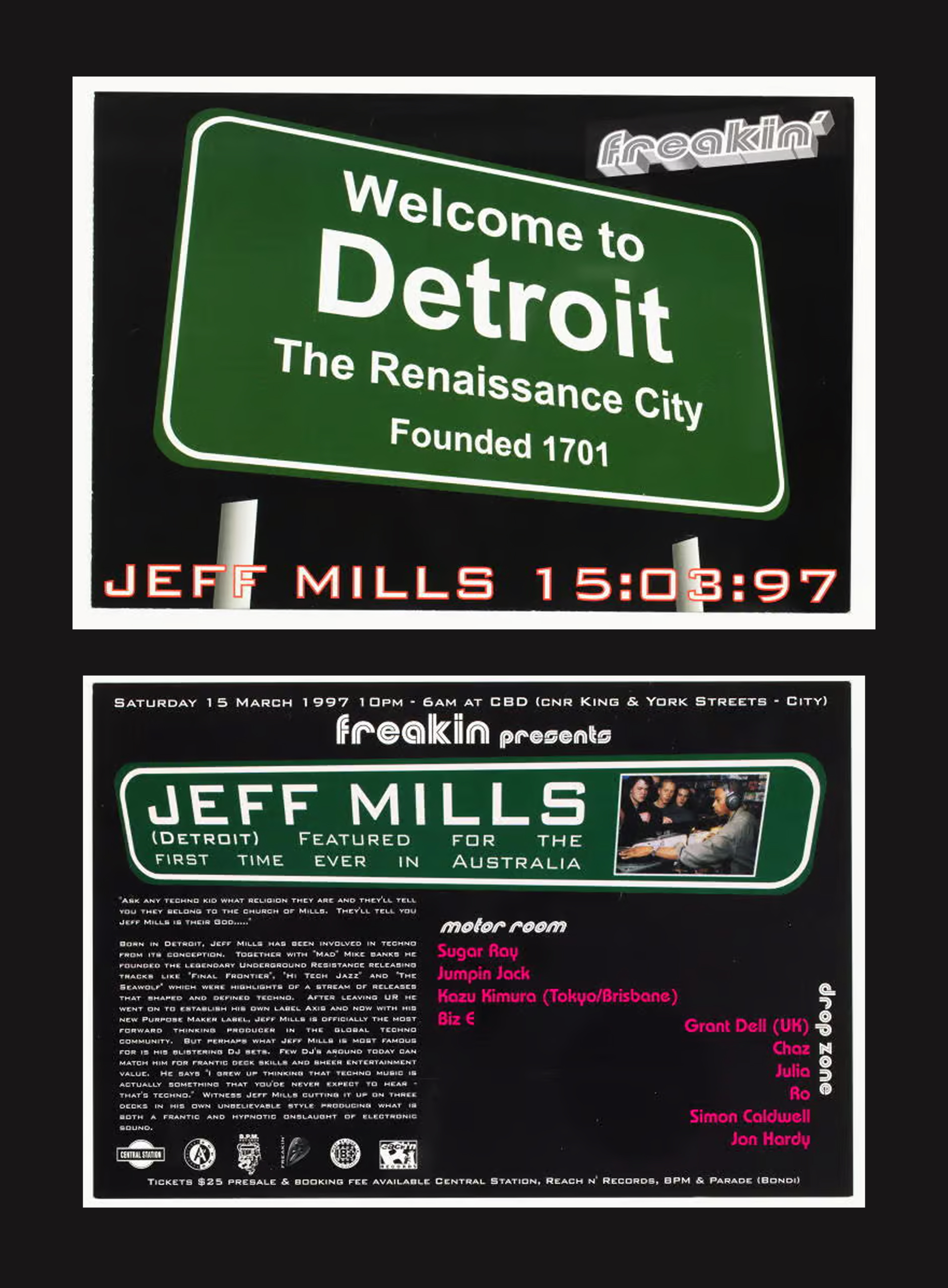
By the time Mills hit full stride, the heat had become unbearable. Someone punched out a window. “I was sitting on the street with a friend because it was getting too hot for us,” recalls punter David Gillies now. “We were only a few metres away from where the broken glass came crashing down.”
Behind the decks, Mills was a blur of focused, virtuosic mixing and ferocious techno. For those who could handle the heat, it was a night worthy of the hype.
The previous year, Mills’s mix album Live at the Liquid Room, Tokyo had landed like a thunderclap. Three decades later, it still endures - serving as the foundation for Mills’s world tour, landing this weekend at the Sydney Opera House for Vivid Live. Described by Pitchfork’s Gabriel Szatan as “a mix of such molten intensity that it warped the idea of what DJing could be”, Live at the Liquid Room captured in vivid detail the breathless power of one of Mills’s club sets. It marked the next evolution of the otherworldly skills he first showcased in his early years as ‘The Wizard’, the dazzling Detroit radio DJ whose funky, fast-cutting sets drew inspiration from figures like Grandmaster Flash and Marley Marl.
Before Live at the Liquid Room, there was Underground Resistance. Mills and Mike Banks formed the revolutionary, hard-edged Detroit techno collective in 1989, later joined by fellow techno evangelist Robert Hood. Through records like Sonic Destroyer, released under the alias X-101, the group exploded into international consciousness. Dimitri Hegemann, founder of Tresor, later recalled the track “conquer[ing] the Berlin clubs overnight.”
In 1992, a flyer began circulating in Sydney announcing Underground Resistance for a show at the storied rave venue and community gathering space Graffiti Hall of Fame on Botany Road in Alexandria. Billed to run from 10pm until midday, the night promised “10 keyboards, DJs and M.C.” appearing “direct from Detroit, Michigan.”
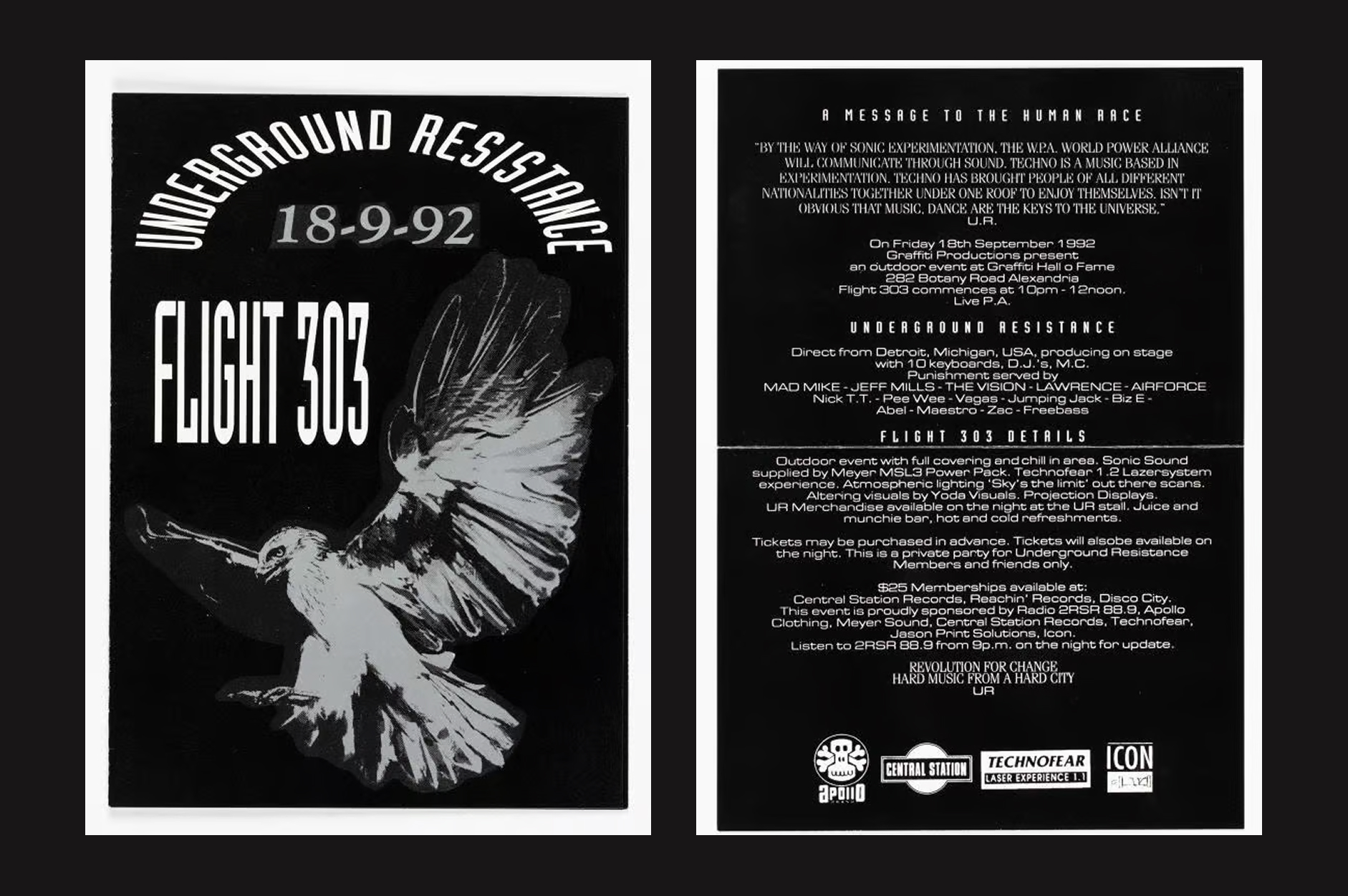
Though Jeff Mills was named on the flyer, by September 1992 he was already holding down a residency at New York’s Limelight. The Sydney contingent of UR was instead led by ‘Mad’ Mike Banks, Robert Hood - billed as “The Vision” - and Mills’s replacement Alan Oldham, aka T-1000, alongside support from some of Sydney’s finest rave DJs.
Among the dancers that night was DJ and Detroit devotee Patrick Wacher, known in the ‘90s as Pat HAF - short for “Hard As Fuck” - and the co-founder of pioneering Australian dance label Southern Outpost. “That was a hard-as-nails performance,” Wacher recalls when we speak at his home in San Francisco, where he has lived since relocating from Sydney two decades ago.
He remembers UR tracks like The Seawolf and Punisher booming around the outdoor dancefloor. “Hearing that music in that environment - outdoors, in this huge brick space - it felt like you were getting pummelled,” he says. “Maybe some of the chemicals helped, but people were really, really up for it. I remember it being completely all-encompassing. It was hard, it was loud, and afterwards it felt like your head had been beaten in.” Wacher also recalls Mike Banks spending time in Redfern meeting Aboriginal Elders on that trip, adding: “That was such a cool thing to hear about.”
Beyond that night, Wacher developed a connection with Mike Banks through a perfectly ’90s channel. As an avid collector of Detroit records, he noticed the office phone number printed on the back of Underground Resistance sleeves and decided to call it.
Banks himself answered. Excited to hear that UR had devotees on the other side of the world, he stayed in touch with the Sydney DJ. After Banks’ Submerge Distribution picked up Southern Outpost, he offered to send Wacher a white-label copy of “Knights of the Jaguar”, the tunnelling techno anthem produced by DJ Rolando under his Aztec Mystic alias.
“A week later, I got this cardboard box in the mail with ‘Knights of the Jaguar’ scribbled on the label,” Wacher recalls. “I knew straight away this thing was going to kick off.” At the now-defunct Dendy Bar, Wacher played what was likely the only copy in Sydney to a feverish response, before rinsing the record relentlessly in the months that followed.
Fast forward to Jeff Mills’s 1997 appearance at the Hotel CBD, and Wacher was once again in the thick of it, battling through what he describes as a “freaking nightmare to get up the stairs” to see Mills. “That gig was just nuts,” he adds. “I’ve never been so drenched at a show - it was nasty.”
Also there that night was Sydney techno stalwart Peter Elmaloglou, aka Biz-E. By his own estimate, he supported almost every visiting techno DJ passing through the city at the time - including Mills, whom he had the unenviable task of following that night on what Patrick Wacher describes as “destroyed” speakers. “That was the first time I’d really experienced Jeff Mills playing live,” Elmaloglou recalls. “The energy was just fucking mind-blowing.”
One of a tight crew of devoted Detroit “fanboys” in Sydney, Elmaloglou says he connected most deeply with the X-101 records. “That was really the first time we’d heard tough techno that just pumped out of the speakers like that,” he says. The 1997 gig has stayed with him. “I think with all those DJs, where they really shone was in low-ceiling, jam-packed rooms,” he recalls. “His head was about a foot below the ceiling, and the place was rammed. That was very exciting.”
The following year, Jeff Mills returned for Apollo ’98, a trailblazing festival staged across Sydney and Melbourne that also featured a young Thomas Bangalter of Daft Punk. Mills played after Sydney local Ken Cloud at 5am, delivering a three-deck set that has since taken on near-mythic status. (Other cities have their own version of this, like the time Mills played in the Adelaide University cloisters, followed by homegrown techno export DJ HMC.)
As veteran DJ Phil Smart told me in 2020 for my Apollo ‘98 oral history for Red Bull: “The memory’s as vivid as if I was there right now. We were all standing backstage with our jaws dropping. You could see from behind how he just smashed through the records. He was on three decks, ripping records out and just dropping them down in their covers. It was absolutely amazing to watch.”
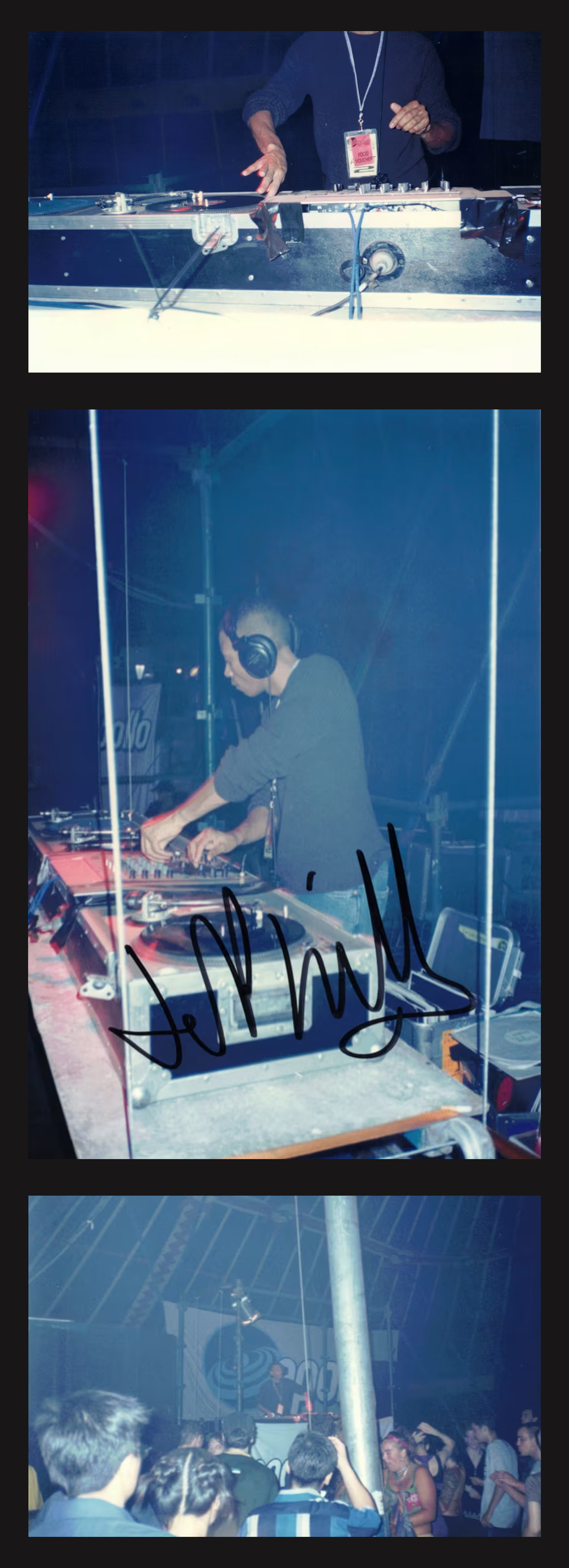
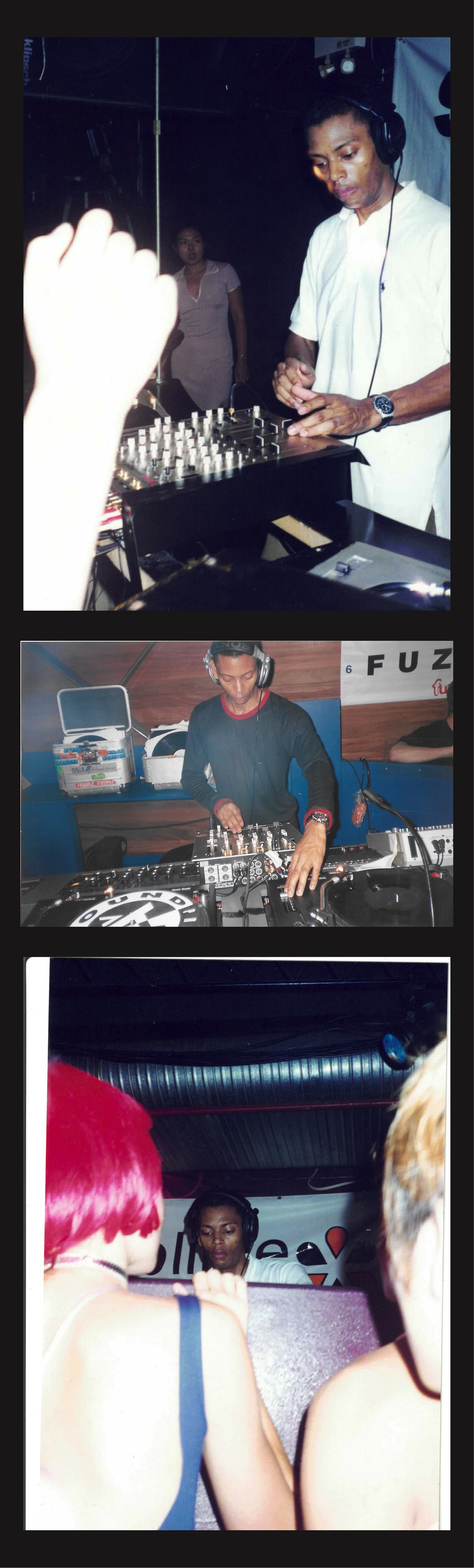
From there, Mills’s relationship with Sydney deepened - not to mention his already established ties to Melbourne. He returned repeatedly over the following years, including a 1999 set at Sublime on Pitt Street - captured in this feature’s photographs by Rozie Wong - followed by another appearance at Home nightclub in 2000. Then, in 2001, he played Artificial at the now long-gone Sega World at Darling Harbour, staged by Field Day promoters Fuzzy.
When Jeff Mills returned in 2004 for an Australian tour coordinated by Melbourne promoter Hardware, Sydney promoter Mainline secured him for a Thursday night show at Home. Earlier that year, Mills had released Exhibitionist, an unvarnished mix that showcased his mastery of three decks and the Roland TR-909 drum machine as a live, in-the-moment instrument.
Ahead of promoting the 2004 show, Mainline co-founder and DJ Methodix had his own conversion moment after witnessing Mills perform at Home in 2000 - and landed a one-of-a-kind gift. This is how he remembers it.
Methodix:
“I’d already started trying to mix three decks - I had three turntables at the time - and I was experimenting with this whole method. That night [in 2000], I watched him intently for the entire set. Somehow I managed to get myself up onstage next to his record box, and I just stood there studying everything he was doing.
At the end of the set, the club closed and they were ushering everyone out, but I was still onstage talking to him. He told security, “No, he’s cool, he can stay,” and we ended up sitting there for about half an hour. We started off talking about DJing, then somehow drifted into space and really deep stuff. At one point I called my friends asking where they were, and they’d already gone home. I think I stayed in the club for at least another half hour after it shut.
My next Jeff Mills experience was buying my first 909. I bought it from [Fuzzy co-founder] Jon Wall, and I noticed Jeff’s signature on it. I said, ‘Wait - this is the 909 he’s been using?’ And Jon said, ‘Yeah, this is the one Jeff uses every time he comes out and plays for me.’
So I ended up buying the exact 909 Jeff had been using. Jon told me, ‘As long as you know that next time Jeff comes back, he’ll want to use it again,’ and he gave me a good price on it. At that point I was still learning my own craft, but that night [at Home in 2000] had been a massive influence on me.
The next time Jeff came out, he played at Sega World. Then later, when I was running parties in Sydney with my friend Sam as Mainline, Richie [McNeill] from Hardware called me and said, “Jeff Mills is coming out again. Could we maybe do something midweek in Sydney?” And it ended up being just as good. Such an incredible gig.
Jeff came on and absolutely destroyed the place. He used the 909 again, and I remember when he walked over and saw it set up, he said, ‘Ah, I know this 909 - I love it.’ He was talking about how much he loved the kick drum and the sound of it.
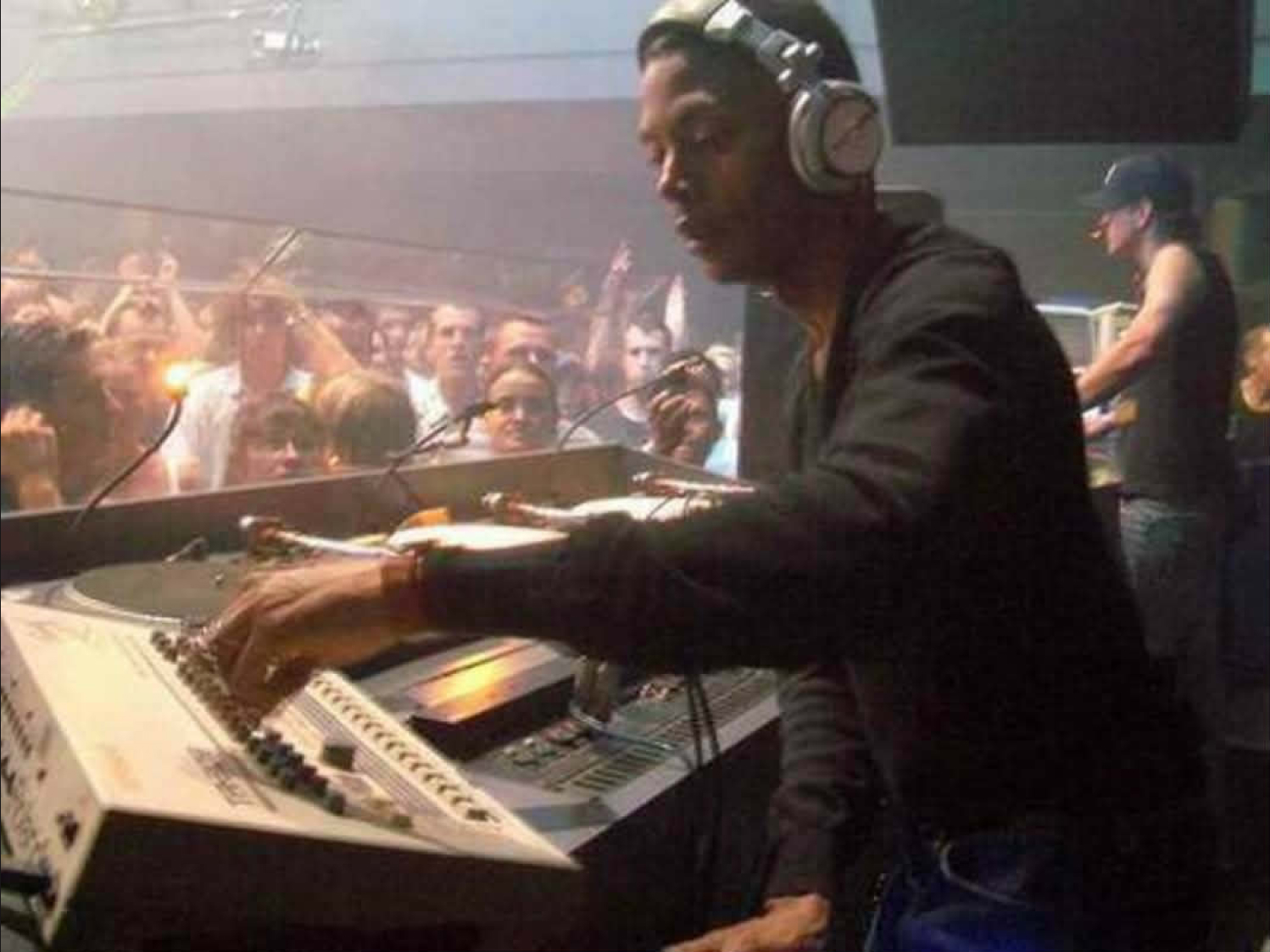
Then afterwards he said, “I left you a present.” I had no idea what he meant. But when I got home, I realised he hadn’t wiped the machine or done a factory reset - he’d left all his loops in there from the night. That was pretty fucking special. Of course I sampled those loops and kept using the 909 with Jeff’s live patterns still inside it. Having the loops he’d been banging out at the party I put on…that was something really special.”
Like a true Jeff Mills obsessive, Methodix is attending both nights at the Sydney Opera House this weekend. He still owns the 909.
Jack Tregoning is a music and culture writer based in Sydney.
Read more of his work: 'Club 77: An Oral History', Sydney to Berlin: Deepa and Matt Vaughan on playing Panorama Bar & Annabelle Gaspar and Simon Caldwell on Bringing Sydney to Berlin's Panorama Bar.
Article Hero Photograph: Jeff Mills at Sublime on Pitt Street 1999 by Rozie Wong







.jpg)


.png)

.jpg)

.png)
.jpg)

.jpg)


.png)
.jpg)


.webp)
.png)


.webp)
.webp)
.webp)

.webp)


